 ZZTool
Depreciation Explained: Methods, Examples, and How to Calculate It Easily
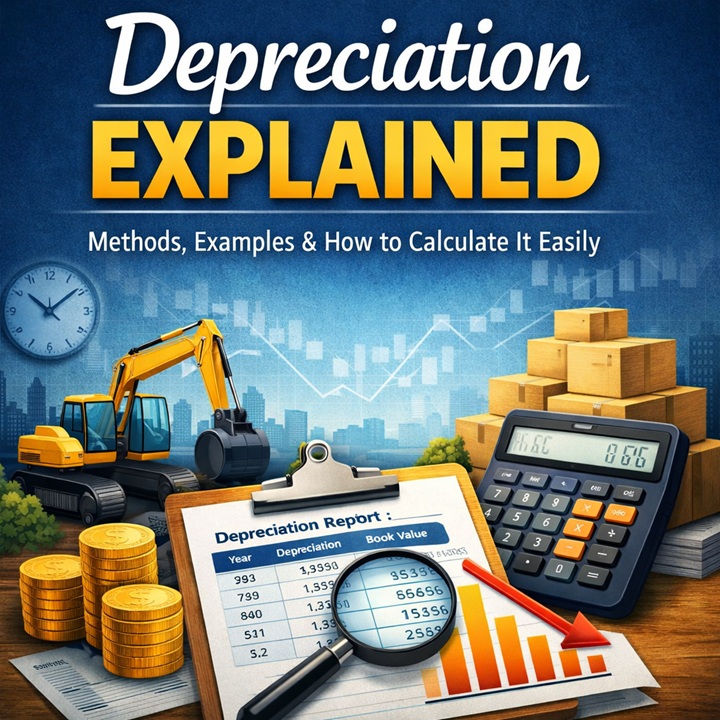
Depreciation is one of the most fundamental concepts in accounting and financial management, yet it is often misunderstood or overlooked. Whether you are a business owner, accountant, freelancer, or investor, understanding depreciation is essential for accurate financial reporting, tax planning, and asset management.
In this article, we will explore what depreciation is, why it matters, the most common depreciation methods, and how an online depreciation calculator can help you quickly and accurately compute depreciation without complex spreadsheets.
What Is Depreciation?
Depreciation refers to the gradual reduction in the value of an asset over time due to usage, wear and tear, aging, or technological obsolescence. Instead of recording the full cost of a long-term asset as an expense in the year it is purchased, depreciation spreads that cost across the asset’s useful life.
This approach provides a more realistic picture of a company’s financial performance and asset value over time.
Why Depreciation Matters
Depreciation plays a crucial role in several areas:
- Financial statements – Ensures assets are not overstated on the balance sheet
- Profit calculation – Allocates asset costs fairly across accounting periods
- Tax planning – Depreciation expenses often reduce taxable income
- Asset management – Helps businesses plan replacements and upgrades
- Investment analysis – Improves accuracy when evaluating profitability
In short, depreciation is not about losing money—it is about accurately allocating costs.
Key Components of Depreciation
Before calculating depreciation, it’s important to understand the basic elements involved.
1. Asset Cost (Initial Cost)
This is the total cost required to acquire the asset and prepare it for use. It may include the purchase price, delivery fees, installation costs, and other related expenses.
2. Salvage Value (Residual Value)
The estimated value of the asset at the end of its useful life. This is the amount you expect to recover through resale or disposal.
3. Useful Life
The estimated number of years the asset will generate economic benefits. Different assets have different useful lives depending on industry standards and usage conditions.
These three values form the foundation of all depreciation calculations.
Common Depreciation Methods
There is no single depreciation method that fits all situations. Different methods are used depending on asset type, accounting strategy, and tax regulations.
1. Straight-Line Depreciation
The straight-line method is the simplest and most widely used depreciation approach. It allocates the same depreciation expense each year over the asset’s useful life.
Formula:
Annual Depreciation = (Asset Cost − Salvage Value) ÷ Useful Life
Example:
- Asset cost: $10,000
- Salvage value: $1,000
- Useful life: 5 years
Annual depreciation:
(10,000 − 1,000) ÷ 5 = $1,800 per year
This method is ideal for assets that lose value evenly over time, such as office furniture or buildings.
2. Declining Balance Method
The declining balance method is an accelerated depreciation approach. It assumes that an asset loses more value in its early years and less in later years.
Depreciation is calculated using a fixed percentage applied to the asset’s remaining book value each year.
This method is commonly used for assets that become obsolete quickly, such as machinery or technology equipment.
3. Double Declining Balance Method
The double declining balance (DDB) method is a more aggressive version of the declining balance method. It doubles the straight-line depreciation rate, resulting in higher depreciation expenses during the early years.
Key characteristics:
- Faster cost recovery
- Higher early-year depreciation
- Lower depreciation in later years
This method is often applied to computers, vehicles, and high-tech equipment.
4. Sum-of-the-Years’ Digits Method
The sum-of-the-years’ digits (SYD) method is another accelerated depreciation technique. It assigns higher depreciation expenses in earlier years using a weighted formula.
How it works:
- Add the digits of the asset’s useful life
- Assign higher fractions to earlier years
- Gradually reduce depreciation over time
Compared to the double declining balance method, SYD is slightly less aggressive but still front-loads depreciation.
Using an Online Depreciation Calculator
Manually calculating depreciation—especially for accelerated methods—can be time-consuming and prone to errors. This is where an online depreciation calculator becomes extremely useful.
With a depreciation calculator, you simply input:
- Asset cost
- Salvage value
- Useful life
- Preferred depreciation method
With one click, the calculator provides:
- Total depreciation
- Annual depreciation amount
- Final book value
- A detailed year-by-year depreciation table
This eliminates manual calculations and ensures consistent, accurate results—ideal for business owners and financial professionals alike.
Real-World Applications of Depreciation
For Small Businesses
Depreciation helps small businesses:
- Reduce taxable income
- Track asset values accurately
- Plan future equipment purchases
- Improve financial forecasting
For Freelancers and Self-Employed Professionals
If you use equipment such as computers, cameras, or tools for work, depreciation allows you to allocate the cost over time instead of expensing it all at once.
For Accountants and Financial Managers
Depreciation directly affects:
- Balance sheets
- Income statements
- Cash flow analysis
- Compliance with accounting standards
Choosing the right depreciation method can significantly impact reported profits and tax liabilities.
Choosing the Right Depreciation Method
There is no universally “best” depreciation method. The right choice depends on:
- Asset type
- Usage pattern
- Financial strategy
- Tax regulations in your country
Straight-line depreciation offers simplicity and consistency, while accelerated methods provide faster cost recovery and tax benefits in early years.
Conclusion: Depreciation Is Cost Allocation, Not Loss
Depreciation is not a sign of financial loss—it is a systematic way to allocate asset costs over time. When applied correctly, it improves financial accuracy, supports better decision-making, and enhances long-term planning.
By understanding depreciation methods and using reliable online tools like depreciation calculators, you can manage assets more effectively and make smarter financial decisions—whether you are running a business, managing accounts, or planning investments.
If you’d like, I can also:
- Optimize this article for SEO
- Rewrite it for a business blog or accounting tutorial
- Add real-world case studies
- Convert it into HTML format for direct publishing
Just tell me 👍
![Free Tile Quantity Calculator Tool [Recommended]](/assets/blog/2026/1787786513_7ee0db51.jpg)